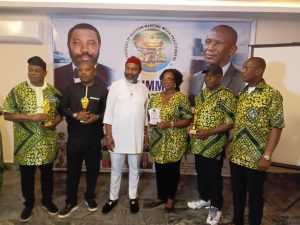
 chief Nweke with some members of CONMMEP who represented awardees.
Story by Dili Utomi.
Advocacy group, the Congress of Nigeria Maritime Media Practitioners (CONMMEP) organised a lecture and awards ceremony to open its third annual general meeting, Thursday. It was an opportuned moment for maritime affairs expert, Chief Eugene Nweke to x-ray the roles of the media in combating illegal trade-smuggling.
Chief Nweke while presenting his paper themed “Maritime Security, Trade Facilitation and the Media: The Role of the Media in Curbing Smuggling in Nigeria’s Maritime Corridor”, he challenged maritime journalists to assume a more strategic role in combating smuggling, strengthening maritime security, and promoting trade facilitation as Nigeria prepares for another election cycle.
Chief Nweke who is the lead researcher at the Sea Empowerment and Research Centre (SEREC), Lagos described the media as a critical stakeholder whose investigative reports, public enlightenment campaigns, and advocacy could significantly strengthen Nigeria’s fight against smuggling and other maritime crimes.
The President of the Congress of Nigerian Maritime Media Practitioners (CONMMEP), Udo Onyeka while earlier welcoming members, industry stakeholders and guests to the association’s 2026 AGM had described the gathering as another milestone in the organisation’s journey.
Chief Nweke also stressed that while the Nigeria Customs Service, the Nigerian Navy, intelligence agencies, and other security institutions play frontline roles in combating illicit trade, sustainable success can only be achieved through strategic collaboration involving government institutions, industry stakeholders, border communities, and the media.
“The battle against smuggling cannot be won by Customs alone. It cannot be won by the Navy alone. It cannot be won by intelligence agencies alone. Nor can it be won by policymakers alone. Success will emerge from strategic collaboration among government institutions, industry stakeholders, border communities, and the media,” he said.
Nweke identified one of the greatest challenges confronting Nigeria’s maritime sector as striking the right balance between effective security enforcement and seamless trade facilitation.
According to him, while excessive regulatory controls could slow down legitimate trade and discourage investment, weak enforcement mechanisms create opportunities for criminal networks to exploit Nigeria’s maritime corridors.
He advocated a balanced approach anchored on risk-based regulations, intelligence-driven enforcement, and technology-enabled trade processes capable of improving operational efficiency without compromising national security.
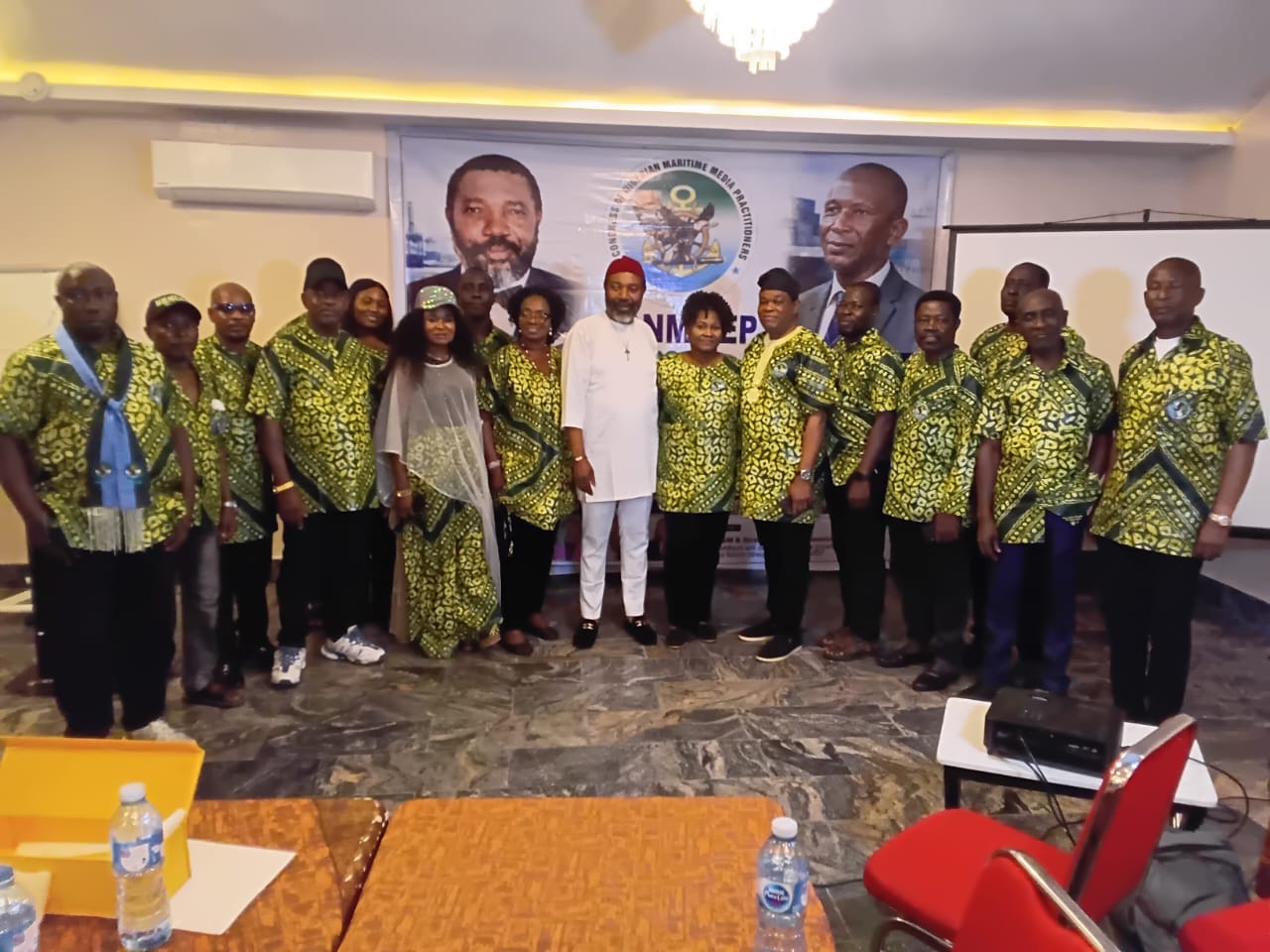
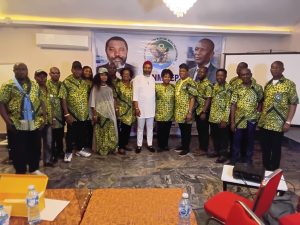 A group photograph with members after the event
“The media has a responsibility to advocate reforms that strengthen both security and trade efficiency simultaneously. Trade facilitation and security are not opposing objectives; they are complementary pillars of sustainable economic development,” he stated.
With Nigeria approaching another electoral cycle, Nweke warned that intelligence and security agencies remain concerned about increased attempts to move small arms and light weapons, hard drugs, illicit financial resources, and politically motivated contraband through the nation’s maritime channels.
He urged journalists covering the maritime sector to remain objective, professional, and patriotic, warning against allowing political interests to undermine national security.
“This period demands heightened vigilance. The media must rise above political affiliations and remain committed to objective reporting that protects national stability. National security must never become a casualty of political competition,” he cautioned.
Addressing maritime journalists directly, the SEREC research head described the profession as occupying a unique position capable of influencing government policies, industry practices, and public perception.
Although journalists are neither regulators nor enforcement officers, he noted that their reports shape public opinion, influence policy decisions, expose wrongdoing, and promote accountability.
“The future requires journalists who are informed, ethical, courageous, professional, and development-oriented. Your voices can either strengthen or weaken national security efforts. The choice rests with the profession,” he remarked.
Presenting a number of policy recommendations, Nweke called on the Federal Government to begin treating smuggling not merely as a Customs violation but as a serious economic and national security crime.
According to him, every shipment used to traffic arms, illicit drugs, counterfeit products, prohibited goods, or evade import duties represents a direct attack on Nigeria’s economy, local industries, public health, national security, and the future of its youth.
He also advocated greater accountability throughout the logistics and supply chain, insisting that importers, exporters, freight facilitators, carriers, terminal operators, and service providers should be subjected to appropriate scrutiny wherever evidence indicates negligence, complicity, or deliberate misconduct.
Nweke further challenged maritime journalists to become “the first line of public awareness and the last line of accountability,” stressing that professional responsibility should always take precedence over personal relationships and institutional patronage.
“The future of maritime journalism lies not in proximity to power but in commitment to truth, transparency, accountability, and national development,” he declared.
He maintained that if these reforms are implemented, Nigeria’s maritime industry would become safer, more transparent, globally competitive, and more attractive to legitimate trade and investment.
CONMMEP president, Onyeka had informed the audience at the event that the association has recorded remarkable growth since its establishment in 2021, emerging as a respected professional body committed to promoting excellence in maritime journalism and fostering constructive engagement within the Nigerian maritime industry.
He commended members for their loyalty, professionalism, and commitment to the association’s ideals, while appreciating the Executive Council and committee members for their dedication over the past year.
Onyeka said the association deliberately selected Dr. Eugene Nweke, a respected maritime practitioner, researcher, educator, and conference speaker, to deliver this year’s keynote lecture because of the relevance of the subject to Nigeria’s economic development and national security.
Expressing optimism about the future of the association, Onyeka said the annual lecture would stimulate meaningful discussions capable of strengthening both the maritime industry and journalism profession.
The keynote lecture concluded with a strong appeal for collective action against smuggling and maritime crimes.
Nweke urged journalists to embrace investigative reporting, public education, and accountability journalism as powerful tools for protecting Nigeria’s economic sovereignty.
He maintained that every successful anti-smuggling operation safeguards government revenue, protects jobs, strengthens national security, and contributes to sustainable national development.
“Together, let us promote a maritime sector where legitimate trade thrives, criminal networks fail, and national development prospers,” he concluded.
The AGM also feature the presentation of the CONMMEP Leadership Excellence Awards to distinguished personalities in recognition of their outstanding contributions to leadership, national development, and service to humanity.
For advertisement and more information, please contact us 08027590195, 08035721540 or email us at greatalternativenigltd@gmail.com, diliutomi1@gmail.com. or send us messages on x @dn_utomi or on Instagram @utomidili