
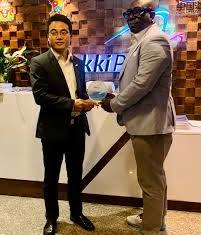

Story by Dili Utomi.
The Managing Director of the Nigeria Ports Authority, Dr. Abubakar Dantsoho has continued to give Ports Managements everything to do excellent jobs, his blueprint is what is being implemented at the various Ports. The need to improve on efficiency in line with international best practices has usually been advocated by the Managing Director and the Minister of Marine and Blue Economy, Adegboyega Oyetola.
One of the success stories of the NPA MD is the $1.5 billion Lekki Deep Sea Port which commenced operations in April 2023 with a capacity to process about 1.2 million cargoes annually as it continues to gain commendation for its various operational milestones. The Port which has the deepest draught of all the ports in Nigeria with a level of minus 16.5 metres and sits on a 19 hectare land area is one of the ports under the Nigerian Ports Authority with Emmanuel Anda as the Port manager.
The Lekki Port has successfully transhipped over 62,000 twenty foot equivalent units (TEUs) to various West African countries, its smart port model is unique in Nigeria and the short turn around time for vessels stands at just 2 days. The physical layout of the Port has a 2 kilometres break water ridge which calms the waves from the harbour with a 9.6 kilometre channel providing the way for the 4 tug boats used by the Port to bring in the large vessels that drop the cargoes.
The Port has a 680m quay length, with a breakwater of 2km for the Phase 1 operations. Upon expansion to Phase 2, the quayway will be extended to 1,500m, and the depth will become minus 19.5meters in the near future. The Port’s development was made possible through a 45-year Build, Own, Operate and Transfer (BOOT) model from NPA.
The scanners only need about 33 seconds to scan a container as soon as the 5 gantry (ship to shore cranes) have done the usual evacuation. The stacking method follows the 7 wide , 6 heights system. Movement of the container from ship to shore takes a maximum of 3 minutes and presently, about 20% of the cargoes are evacuated through barges. The Port’s integrated automated operations makes business easier for the Port users.
From January to August 2025, the port recorded 88,432 TEU imports, 123,013 TEU exports, 62,581 TEU transhipment moves, 16,925 TEU restows, and 34,710 TEU barge movements with a projection to handle over 500,000 TEUs by end of 2025. Transhipment already represents 38 per cent of total activity, signalling the port’s growing hub status.
The Lekki Port manager, Emmanuel Anda has also been praised for his contribution in improving the Operational Services at the Port which has seen the Port engaging in various innovative operational methods and also the transhipment of cargoes. The Port has evolved into a strategic maritime gateway, reshaping the logistics landscape of West Africa and opening new corridors for trade and industrial ambition across the continent.
The port facility includes three container berths, three liquid bulk berths and one dry bulk berth. The dry bulk and liquid terminal operations are in view. The Port is presently operating around 50% of its designed capacity. Barge operations currently account for 20% of cargo movement, but rail connectivity is essential for long-term efficiency, particularly with the Lekki Free Zone’s industrial activities.
Lekki Port’s technological design integrates automated gates, OCR systems, ship-to-shore cranes, rubber tyred gantry cranes, FS 6000 drive-through scanners, truck parks, and advanced control systems.
Its berth productivity averages 18 to 20 moves per hour, with truck turnaround time at approximately 45 minutes and container dwell time at 12 to 13 days. The Port is currently Nigeria’s second-largest terminal.
The nation’s Port regulator is equally convinced of Lekki’s transformational impact. Lekki Port Manager, Nigerian Ports Authority (NPA), Mr Emmanuel Anda, said the port had recalibrated West Africa’s maritime geography.
“For the first time, Nigeria is handling ultra-large vessels efficiently; Lekki is deepening Nigeria’s presence on global shipping routes and strengthening our maritime competitiveness. He said that the port was significantly boosting export activity, helping Nigeria approach a healthier balance of trade. “The continued progression could see Lekki become a global export hub within 10 to 15 years”. Mr. Anda added.

Road infrastructure upgrades are ongoing, and the planned Lagos Green Line rail connection will significantly boost cargo evacuation and accessibility.
In the wider West African theatre, where the African Continental Free Trade Area (AfCFTA) is opening unprecedented opportunities, Lekki Deep Sea Port offers something rare: scale, speed and unmatched efficiency.
Amid capacity constraints in neighbouring countries and rising demand for deep-water logistics, Lekki gives Africa a competitive edge. On an ordinary day, containers rise like a new skyline, cranes swing rhythmically over the quayside, and massive ships glide into position. Beneath the mechanical precision is something more profound: a new economic centre is being born on the Nigerian coastline.
Presently, exports are surpassing imports, there is free-flowing cargo movement in and out of the seaports and Dangote Refinery, plus port automation—including marine operations like the 4 tugboats and efficient barging—the story centres on seamless activities within the pilotage district.
The Minister of Blue and Marine Economy, Mr Adegboyega Oyetola has also said that the Federal Government estimated more than 170,000 direct and indirect jobs would be created over the 45-year concession period and revenue contributions of 158 billion dollars, alongside 361 billion dollars in GDP impact from the project.
For advertisement and more information, please contact us 08027590195, 08035721540 or email us at greatalternativenigltd@gmail.com, diliutomi1@gmail.com. or send us messages on x @dn_utomi or on Instagram @utomidili


