
Story by Dili Utomi
Nigeria’s Maritime Crossroads: Industry Voices Chart a Course for Revival at PortNews Summit 2025.
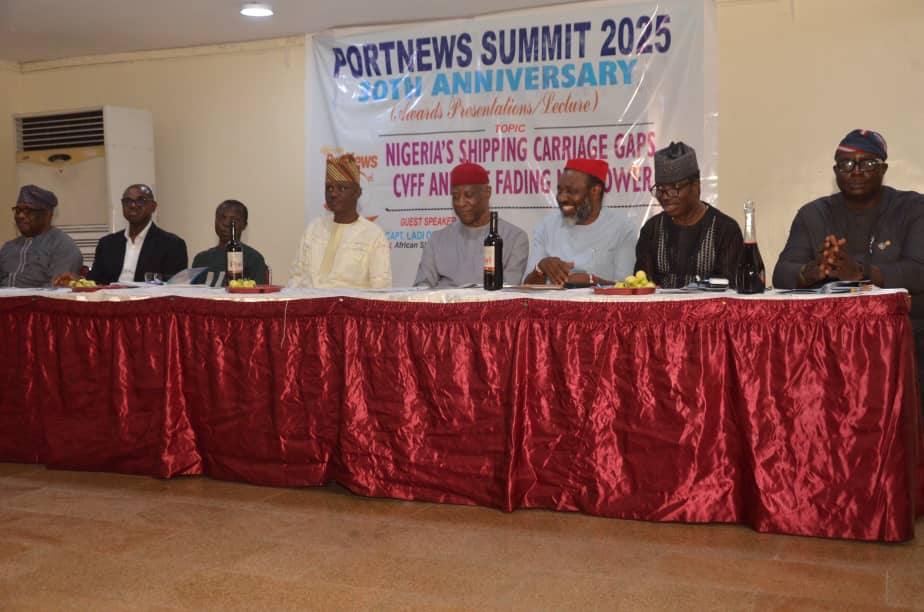
Three decades after PortNews first began chronicling the tides of Nigeria’s maritime story, its 2025 Summit became more than an anniversary—it became a reckoning. As industry veterans, regulators, and seafarers gathered in Lagos, the mood was clear: Nigeria’s maritime industry is drifting, and only urgent reform can bring it back to course.
With the theme “Nigeria’s Shipping Carriage Gaps, CVFF, and the Fading Manpower,” the summit peeled back layers of neglect and inertia that have left the once-vibrant sector struggling to stay relevant.
Former Minister of Interior and Chairman of Genesis Worldwide Shipping, Captain Emmanuel Iheanacho, chaired the event, setting a tone of sober reflection mixed with cautious hope. The keynote came from Captain Ladi Olubowale, President of the African Shipowners Association, who delivered what many attendees described as both a history lesson and a call to arms.
A Lost Fleet, A Lost Fortune
Olubowale’s address evoked memories of the Nigerian National Shipping Line (NNSL), whose 27 vessels once carried the nation’s flag proudly across global trade routes.
“Those ships symbolised our strength,” he recalled. “Today, we cannot point to one active national carrier. Our maritime laws are outdated, our vessels are gone, and our seafarers are stranded.”
He underscored the urgent need to reform the Carriage of Goods by Sea Act, which he described as “frozen in time” and out of sync with modern realities such as electronic documentation and multimodal transport. Aligning with the Rotterdam Rules, he argued, would re-anchor Nigeria within international shipping frameworks.
But the numbers told an even grimmer story: over 90% of Nigeria’s maritime trade, including crude oil, LNG, and agricultural exports, remains in foreign hands.
“In 2013 alone, $9 billion in freight earnings left this country,” Olubowale revealed. “We generate the cargo, but others own the ships. That’s a monumental economic leakage.”
The CVFF Question: Promise or Mirage?
No topic stirred more emotion than the Cabotage Vessel Financing Fund (CVFF)—a pool of over $800 million designed to empower local shipowners but still largely untouched.
“We’ve heard of this fund for two decades,” Olubowale said, “yet there’s no transparency, no access. Where is the money and who has benefited?”
He criticises the equity requirement demanding Nigerian shipowners contribute 50% of financing. “In this economy, that’s unrealistic,” he said bluntly. “The framework is designed to fail the very people it was meant to uplift.”
Manpower in Crisis.
Beyond ships and policies, another deficit looms large—people. Thousands of maritime cadets remain without the mandatory sea-time needed to qualify as officers.
“We are training seafarers who never touch the sea,” Olubowale lamented. “If ships were to return tomorrow, 80% of their crews would still be foreigners. Our human capital is wasting away.”
He called for urgent collaboration between NIMASA, shipowners, and maritime academies to restore cadetship placements and rebuild a seafaring culture.
A Path Forward
Chairman Iheanacho echoed the call for reform but urged optimism. “We once ran vessels that met global standards,” he reminded. “Our problem isn’t capacity—it’s continuity. With sincerity in cabotage enforcement and policy execution, we can recover our lost ground.”
For Mr. Wale Oni, Publisher and Editor-in-Chief of PortNews, the summit carried a dual meaning: celebration and reflection.
“This newspaper began as a leap of faith,” he said. “Thirty years later, we remain the conscience of Nigeria’s maritime sector—asking the questions others won’t.”
Oni pledged that PortNews would continue its advocacy for accountability and progress. “Our mission remains the same—to keep Nigeria’s maritime story alive, and honest,” he affirmed.
As the summit drew to a close, one sentiment echoed across the room: the ocean will not wait.
Nigeria’s maritime future depends not on speeches but on action, transparency, and the courage to reform.
“We can either keep watching others sail ahead,” Captain Olubowale concluded, “or we can build our ships, train our people, and take back our place on the water.”
For advertisement and more information, please contact us on 08027590195, 08035721540 or email us at greatalternativenigltd@gmail.com, diliutomi1@gmail.com or send us messages on x @dn_utomi