

 Speakers at the DMP 3.0 event.
Story by Dili Utomi.
Experts playing within the maritime sector of the Nigerian economy gathered on Thursday to speak their minds at the National Discourse 3.0 of the Distinguished Maritime Personalities seminar. The event which was organised by the Maritime Nigeria witnessed experienced industry players talk critically about what needs to be done to improve every area of the sector.
The opening speech by the convener, Igho Kelvin Kagbare touched on the theme of the day’s event which is “Port Modernisation: Automation, Regulation, Administration and Competencies”. He noted that the theme “resonates with the urgent need to reposition our maritime industry for global relevance and sustainable growth”.
Mr. Kagbare advised thus “As we engage in robust discussions, paper presentations, and strategic reflections, let us remember that the future of Nigeria’s maritime sector depends on our collective resolve to modernise, regulate, and empower”.
Captain Warredi Enisuoh in his presentation dealt basically on the issue of automation. He said that automation is meant for efficiency, safety, business growth and time saving.
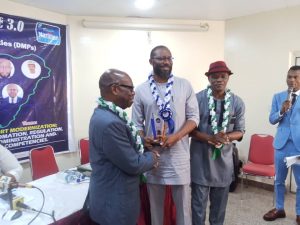 Captain Enisuoh receiving an award at the event.
The maritime expert said that for a port to be considered automated, 2 things are to be considered namely;
1. Mechanical side which includes: Hydraulic, mechanics and pneumatics
2.Electronic side which includes: electrics and electronic.
Captain Enisuoh went on to detail that for a fully automated port, 3 conditions need to be fulfilled:
1. Yard: Must be fully automated with the global positioning system (GPS), an automatic guided vehicles (AGV) and automated stacking cranes (ASC).
2. Terminal: Must have automated global system (AGS) and automated ship to shore cranes (ASSC).
3. Foreland and Hinterland: The cargo evacuation mechanisms such as trucks, trains and warehouses must adequate.
Among many advantages, Captain Enisuoh said that the impacts of automation include possible reduction in operating expenses of up to 50%, better utilisation of spaces, fewer labour force, possible increase in productivity, rapid access to data, better security, improved turnaround time for ships, enhanced multimodalism, noise reduction, creates new opportunities and many more.
Though he added that there can also be
some demerits in automation in terms of substantial risks, loss of jobs, the need for a highly trained workforce and a few other disadvantages.
Captain Sunday Umoren of the Abuja MOU was represented by Mr. Richard Owolabi, he noted in his presentation that “To modernise our ports is to modernise our economy. In a world driven by data and technology, efficiency is now measured in minutes, not days. Countries that have embraced port automation are already witnessing remarkable results. The World Bank’s 2024 Logistics Performance Index shows that digitalised ports record up to 65 percent faster vessel turnaround, 40 percent shorter cargo dwell time, and 25 percent lower operational costs. These are not mere statistics; they are the dividends of foresight and reform”.
 A group photograph after the event.
Marc Onuchi who represented Dr. Segun Musa noted that “The economic rationale for full automation is its superior operational stability and resilience. Data shows that fully automated terminals exhibit better performance, particularly during global
disruptions. During crises, fully automated terminals experienced a significant increase in total terminal profit (25.9%), compared to a decrease (-2.3%) observed at non-fully automated terminals, due to their ability to maintain stable operations and consistent throughput”.
Mrs. Rollens McFoy while drawing comparison between Nigeria’s ports system and those of India and United Arab Emirates noted that we need to review our operations and then modernise them while also developing other Ports outside of Lagos.
Her words “God forbid that there is a fire at any of the tank farms in Lagos because most parts of Lagos will burn down”. She noted that the port environment in Lagos is such that they require a lot more resources to really modernise because of the physical environment which is a key factor in Ports development, modernisation and growth.
Mrs. McFoy added that Nigerian ports need automation in areas like cargo handling, gate access and traffic management and documentation and logistics. Key automation needs include automated cranes and vehicles for efficient loading and unloading, a fully integrated electronic truck call-up system for scheduling and access control and digitised systems for processing documents to speed up Customs and clearance processes.
In an interview with Captain Enisuoh after the event, he said that” We need to have superior thinking in order to be able to automate the ports as we have a whole lot of crowded areas around the ports, but that is not impossible. In automation, everywhere is interlinked and should work in synchronised manner. If we are serious about it, people should be settled properly away from the ports areas and then the ports fully automated and modernised”.
In the area of port maintenance, he also added that the Nigeria Ports Authority should be on top of its game in order to have all the ports in good conditions, always.
For advertisement and more information, please contact us 08027590195, 08035721540 or email us at greatalternativenigltd@gmail.com, diliutomi1@gmail.com. or send us messages on x @dn_utomi or on Instagram @utomidili

